

Published:

Published:
Greece and Croatia are two of the Mediterranean’s most appealing sailing destinations, and choosing between them is not as simple as picking the country with better beaches or warmer weather. Both offer clear water, hundreds of islands, historic ports, excellent food, and routes that can be adapted to a week or longer at sea. Yet the experience on board can feel surprisingly different.
For travelers planning a Greece vs Croatia vacation, the real choice comes down to sailing style. Greece offers several distinct island groups, from the green Ionian Islands to the windier Cyclades. Croatia combines island hopping with a long, dramatic Adriatic coastline and historic towns that are often only a relatively short sail apart.
Choosing a catamaran charter therefore means deciding what you want to see between one anchorage and the next. Let’s compare the two destinations by routes, conditions, time ashore, and the type of traveler each suits best.
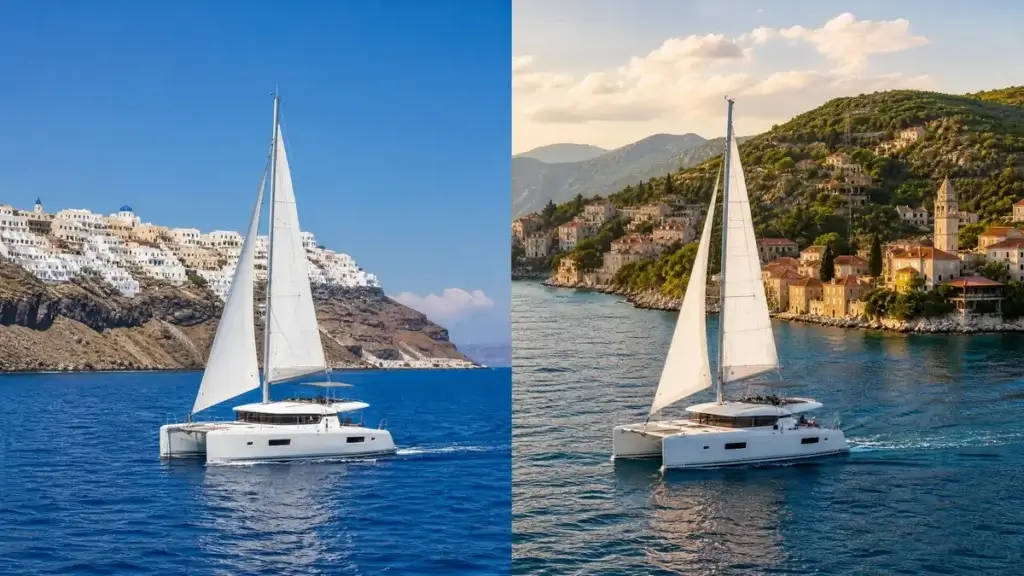
There is no universal winner. Greece generally offers greater variety between its sailing regions, while Croatia stands out for the combination of islands, coastal cities, compact routes, and established marina infrastructure.
Here is the comparison at a glance:
| Factor | Greece | Croatia |
| Sailing style | Diverse island groups and open-water routes | Island and coastal routes with frequent stops |
| Popular areas | Cyclades, Ionian, Saronic, Dodecanese | Split, Hvar, Brač, Korčula, Dubrovnik |
| Landscape | Dry Cycladic scenery to green Ionian islands | Green islands, rocky coves, forested coastline |
| Cultural stops | Ancient sites and traditional island towns | Medieval and Venetian-influenced coastal towns |
| Conditions | Vary considerably between regions | Often suited to relatively compact itineraries |
| Best for | Variety and classic Greek island hopping | Combining sailing with frequent exploration ashore |
The important distinction is that neither country offers just one type of itinerary. A week in the Ionian Islands, for example, can feel very different from a week in the Cyclades. The same applies to sailing around Split compared with a route farther south toward Dubrovnik.
Counting islands does not tell you much about the quality of a sailing trip. What matters is how those islands are distributed, the distances between them, and what you can experience when you arrive.
Greece and Croatia approach this in different ways.
One of Greece’s greatest strengths is variety.
The Cyclades provide the image many travelers associate with the country: whitewashed villages, blue-domed churches, rocky landscapes, and islands scattered across the Aegean. Mykonos and Santorini are the famous names, but a sailing itinerary can also include quieter islands and anchorages away from the busiest ports.
The Ionian Islands feel different. Corfu, Lefkada, Kefalonia, and the surrounding islands are greener, and sailing distances can work well for travelers who prefer a more relaxed rhythm.
The Saronic Gulf provides another alternative, particularly for routes starting near Athens. Islands such as Aegina, Poros, Hydra, and Spetses make it possible to combine time on the water with historic ports and relatively convenient access from the mainland.
Farther east, the Dodecanese offers yet another character, with islands including Rhodes and Kos and strong architectural and cultural influences from different periods of Mediterranean history.
That diversity is the main attraction of a catamaran charter in Greece. You are not choosing only a country—you are choosing between several sailing regions with distinct landscapes, routes, and conditions.
Croatia offers a different geography. Rather than several widely separated archipelagos, much of its best-known sailing takes place along the Adriatic coast and among islands running parallel to the mainland.
Split and Trogir are popular starting points because they provide easy access to islands such as Brač, Šolta, Hvar, and Vis. Farther south, Korčula and Mljet can lead naturally toward Dubrovnik.
This creates an appealing rhythm. A day might begin in a quiet bay, include a manageable sail, and end within walking distance of an old town, waterfront restaurant, or lively harbor.
Hvar is known for its historic center and social scene. Vis feels more remote and has a long maritime history. Korčula combines beaches and coves with an atmospheric fortified old town, while Dubrovnik provides one of the most striking finales to a southbound itinerary.
A catamaran charter in Croatia is therefore particularly attractive to travelers who want sailing and time ashore to have roughly equal importance.
If Greece feels like a collection of different island worlds, Croatia often feels like a continuous journey along one remarkable coastline.
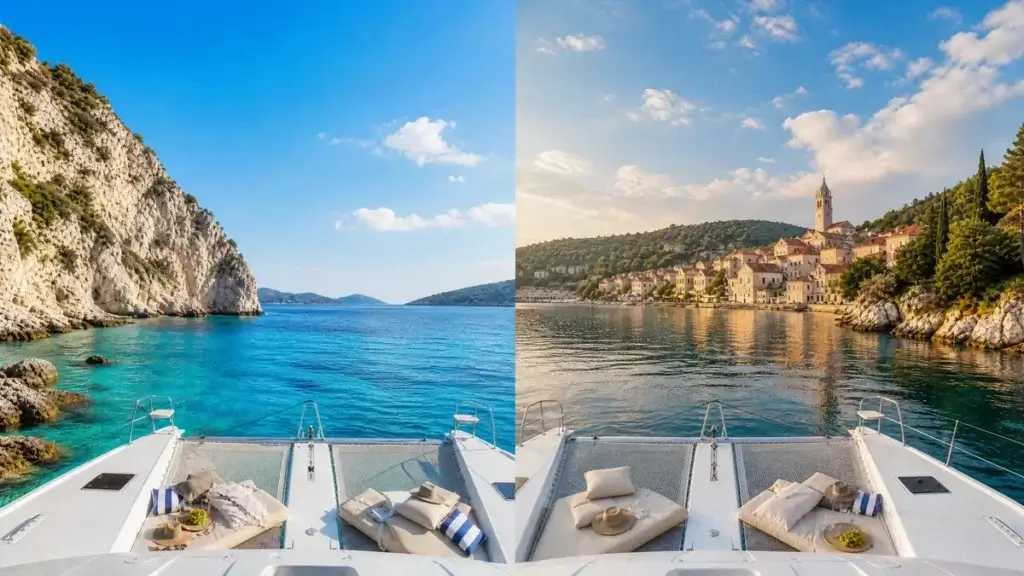
Weather can change any sailing itinerary, so neither Greece nor Croatia should be reduced to a simple label such as “easy” or “challenging.” Conditions depend on the region, month, route, and daily forecast.
Greece has particularly varied sailing conditions because its main cruising areas are geographically different.
The Cyclades are exposed to the Meltemi, a northerly wind that can become strong during summer. For experienced sailors, that can add an exciting sailing dimension to the trip. For families or first-time charter guests, however, it makes route planning and professional local knowledge especially important.
The Ionian Islands generally have a different wind pattern and are often chosen for more relaxed itineraries. The Saronic Gulf can also provide an alternative for travelers who want to remain relatively close to Athens while visiting several islands.
This regional variation is important. Saying “sailing in Greece” without specifying where is a little like discussing the weather of an entire continent. The destination alone does not tell the whole story.
Croatia’s Adriatic coast offers many islands, bays, and established ports, which can make it convenient for itineraries with frequent stops.
That does not mean the weather can be ignored. Local winds can change conditions quickly. The Bora, for example, is known for strong gusts from the northeast, while the Jugo blows from the southeast and can bring different sea and weather conditions. In summer, the Maestral is a familiar daytime wind along parts of the Adriatic.
The advantage of Croatia’s geography is the number of potential ports, bays, and islands available along many routes. This can provide flexibility when planning daily legs, although every itinerary should still respond to the actual forecast rather than a fixed schedule.
For travelers more interested in combining sailing with frequent stops, Croatia can be especially appealing.
A catamaran holiday is not spent entirely on the boat. The places where you drop anchor or step onto the quay often become the memories that last longest.
In Greece, the atmosphere changes from island to island. One evening might end at a family-run taverna beside a small harbor; another could involve walking through a whitewashed Cycladic village or visiting an archaeological site. The country’s long history means ancient ruins, Byzantine heritage and contemporary island life often exist within the same itinerary.
Greek food also suits the rhythm of sailing particularly well. Fresh fish, salads, olives, local cheeses and dishes designed for sharing make a long meal beside the water feel like part of the journey rather than a break from it.
Croatia offers an equally strong but different experience ashore. Along the Dalmatian Coast, Venetian architectural influences, waterfront promenades, and narrow old streets are frequently part of the sailing route.
Food reflects the Adriatic setting: seafood, olive oil, local cheeses and wines are easy to build into an itinerary. Places such as Split, Hvar, Korčula, and Dubrovnik also offer considerably more nightlife and sightseeing than a remote anchorage.
The difference is subtle but useful when choosing. Greece can feel more focused on moving between distinct island communities. While Croatia makes it particularly easy to combine islands with major historic coastal destinations.
The best choice becomes clearer when you stop asking which country is “better” overall and start asking what the people on board actually want from the week.
The composition of the group matters too. A route that is exciting for experienced sailors may not be the best choice for young children or guests primarily interested in swimming and relaxed afternoons.
After comparing the routes, weather, islands, and experiences ashore, the decision becomes easier.
Choose Greece if you want to select from several very different sailing regions. It is particularly attractive if the idea of the trip is centered on island hopping and you want to shape the itinerary around a specific atmosphere—from the green Ionian Islands to the iconic landscapes of the Cyclades.
Choose Croatia if you want to combine island sailing with frequent visits to historic towns and coastal destinations. The geography of the Dalmatian Coast makes it possible to create routes where a quiet anchorage one day is followed by Hvar, Korčula, Split, or Dubrovnik the next.
Greece offers more contrast between its major sailing regions. Croatia offers an exceptionally natural combination of islands and mainland coastal heritage. Both provide clear water, memorable anchorages, excellent food, and enough route possibilities to make two weeks on the same sea feel completely different.
The destination matters, but so does the itinerary. Choosing the right region, boat, and pace will influence the experience far more than simply picking the country that looks best in photographs.
Family Catamaran Holiday: Is It Comfortable and Safe with Kids?
How to Plan a Private Catamaran charter in the Ionian Islands
Greece vs Croatia for a Catamaran Charter: Which Destination Is Better?
What to Pack for a Private Catamaran Charter
The Ultimate Amalfi Coast Guide

Italian Islands
What Is Knot Speed and How Fast Does a Catamaran Go?
How to choose a catamaran charter in Greece
The Best Greek Islands for Catamaran Charter
The History of Sailing Holidays: From Sailboats to Catamarans


