

Published:

Published:
Boat speed can be confusing at first because sailors rarely talk about kilometres or miles per hour. Instead, they use knots. A skipper might say a catamaran is travelling at 7 knots, the wind has reached 18 knots, or the next island is 25 nautical miles away.
For anyone planning a catamaran charter, understanding these numbers makes it much easier to judge sailing times and daily distances. It also helps explain why the fastest possible speed of a yacht is usually far less important than its comfortable cruising speed.
A knot is a unit of speed equal to one nautical mile per hour. One knot equals:
So, if a catamaran is travelling at 10 knots, it is moving at roughly 18.5 km/h or 11.5 mph.
The answer to what is knot speed is therefore quite simple: it tells you how many nautical miles a vessel travels in one hour.
A nautical mile is slightly longer than a regular land mile because it is based on the Earth’s geographic coordinates. This makes nautical miles particularly convenient for navigation at sea, where positions are measured using latitude and longitude.
The term comes from an early method of measuring boat speed. Sailors used a device known as a chip log: a piece of wood attached to a rope with knots tied into it at regular intervals.
The wood was thrown overboard while the rope was allowed to run out for a set period of time. By counting how many knots passed through the sailor’s hands, the crew could estimate the vessel’s speed.
Modern boats use GPS, electronic instruments and chartplotters instead, but the terminology remains.
Today, knots are used not only for boat speed but also for wind forecasts. This is useful because a skipper can compare wind speed and yacht speed using the same unit.
If you have ever wondered what does knot speed mean on a navigation display, it is simply the vessel’s speed expressed in nautical miles per hour.
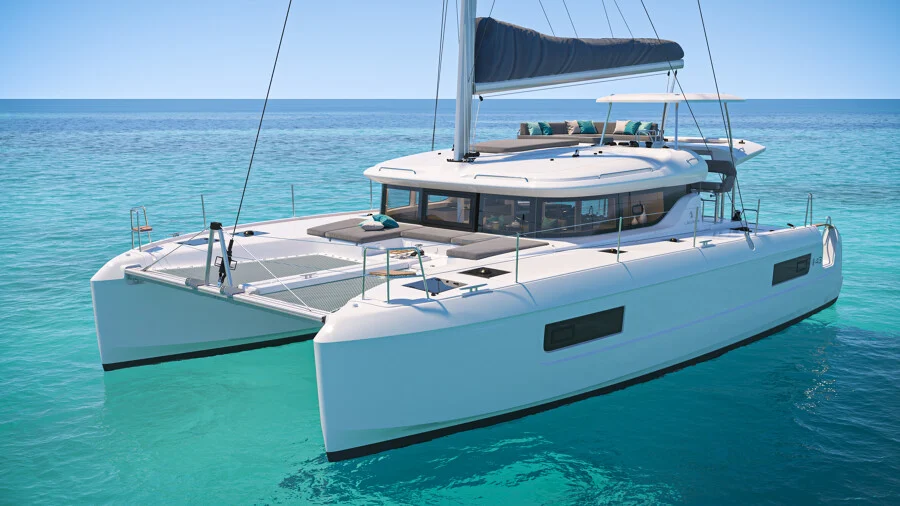
There is no single answer to how fast does a catamaran go because catamarans vary enormously in size, weight and design.
A comfortable cruising catamaran used for holidays behaves very differently from a lightweight performance catamaran or a racing multihull.
In normal sailing conditions, many cruising catamarans travel somewhere around 6-10 knots. Under favourable wind conditions, speeds above 10 knots are perfectly possible, while performance-oriented yachts may sail considerably faster.
The average catamaran speed on a holiday, however, is usually determined by comfort and the itinerary rather than by the yacht’s theoretical maximum.
A skipper may deliberately reduce speed when the sea becomes rough or when guests prefer a smoother ride.
A modern cruising catamaran may often sail at approximately 6-8 knots in moderate conditions. With stronger wind from a favourable direction, 9-12 knots can be achievable on many yachts.
That does not mean a boat will maintain the same speed throughout the day.
Sailing performance changes with:
This is why the answer to how fast do sailing catamarans go is normally given as a range rather than a fixed number.
A yacht might sail at 5 knots during one part of a passage and reach 10 knots later the same afternoon without anything being wrong with the boat.
Most charter catamarans also have engines, usually one in each hull. They are used when there is little wind, when entering or leaving a marina, and whenever maintaining a schedule under sail would be difficult.
Typical motoring speeds for many cruising catamarans are around 6-8 knots.
Although increasing engine revolutions can produce more speed, fuel consumption rises as well. For that reason, skippers generally choose an efficient cruising speed instead of continuously operating at maximum power.
The same principle applies to a catamaran rental: the fastest setting is rarely the most practical one.
The catamaran cruising speed you see on a particular day is the result of several factors working together.
The most important are:
These variables explain why published maximum speeds should never be treated as guaranteed travel speeds.
The conversions below make common sailing speeds easier to visualise.
| Knots | Miles per hour | Kilometres per hour | Practical meaning |
| 5 knots | 5.8 mph | 9.3 km/h | Relaxed sailing in lighter conditions |
| 7 knots | 8.1 mph | 13.0 km/h | Typical comfortable cruising pace |
| 8 knots | 9.2 mph | 14.8 km/h | Good progress on a charter passage |
| 10 knots | 11.5 mph | 18.5 km/h | Fast cruising for many charter cats |
| 12 knots | 13.8 mph | 22.2 km/h | Strong sailing conditions |
| 15 knots | 17.3 mph | 27.8 km/h | Fast for a typical cruising catamaran |
| 20 knots | 23.0 mph | 37.0 km/h | Usually associated with performance sailing |
These figures also show why speed at sea can feel different from driving on land. A boat travelling at only 8 knots can still cover a substantial distance when it maintains that pace for several hours.
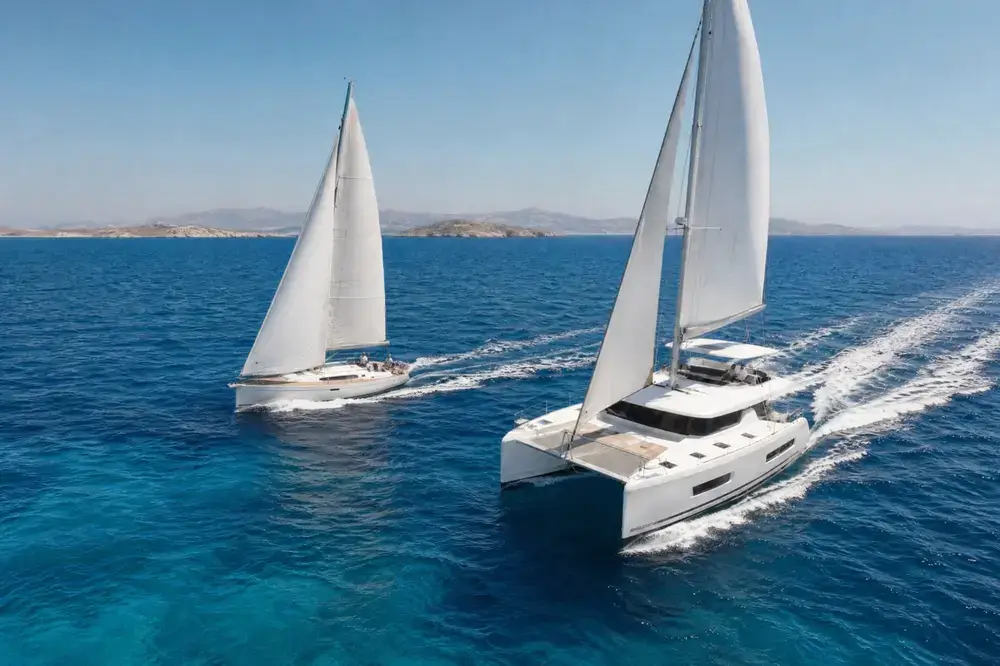
Sometimes, but not always.
Catamarans have two relatively narrow hulls and do not need the heavy ballast keel used by most monohull sailing yachts. This can reduce resistance and allow some multihulls to accelerate quickly, particularly when reaching or sailing downwind.
They also sail with much less heel.
However, a catamaran is not automatically faster simply because it has two hulls. A heavily equipped cruising model may be slower than a lightweight performance monohull, while a racing catamaran can be dramatically faster than both.
Traditional monohulls may also perform better when sailing very close to the wind.
For charter guests, speed is usually only one part of the decision. Space, stability, privacy and deck layout often matter much more.
The basic calculation is straightforward:
Distance in nautical miles = average speed in knots × hours travelled.
For example:
In theory, a yacht travelling continuously at 8 knots for 24 hours could cover 192 nautical miles.
A holiday itinerary is different. Guests normally want time for breakfast, swimming, lunch, anchoring, sightseeing and relaxing rather than spending the entire day underway.
This matters when planning a Catamaran Charter Greece. Island distances, wind conditions and the preferred pace of the group often have more influence on the itinerary than the boat’s maximum speed.
Yes, but probably less than first-time guests expect.
A difference of one or two knots can noticeably change passage time over longer distances. On a 40-nautical-mile leg, for example, travelling at 8 knots takes about five hours, while an average of 6 knots increases the passage to almost seven hours.
That can affect how many islands or bays fit comfortably into a week.
At the same time, selecting a yacht only because it has a higher advertised top speed makes little sense. A good private catamaran charter is usually built around a balanced itinerary rather than maximum daily mileage.
Guests should also consider cabin layout, deck space, comfort, route, crew format and equipment.
The Luxury Catamarans fleet therefore needs to be viewed as accommodation and a sailing platform at the same time, not simply as a way to travel from one harbour to another.
The yacht itself may be capable of the same performance regardless of who is sailing it, but the way speed is managed can be different.
On a crewed catamaran charter, a professional skipper plans passages according to wind forecasts, local conditions, the itinerary and the comfort of the guests.
An experienced crew knows when sailing slightly faster is worthwhile and when reducing speed creates a much more enjoyable trip.
A luxury crewed catamaran also allows guests to focus entirely on the holiday rather than navigation, sail handling and weather decisions.
On a bareboat catamaran charter, those responsibilities belong to the qualified skipper within the group. Passage planning needs to include realistic average speeds, changing weather and enough reserve time to reach the next anchorage or marina safely.
For many cruising catamarans, 6-9 knots means excellent progress in good conditions — though rough water calls for slower speeds, while favourable wind can push things faster without sacrificing comfort. The best cruising speed is simply whatever keeps the yacht safe and on schedule.
That matters most on a luxury catamaran charter, where the goal isn’t covering nautical miles — it’s sailing between destinations while still having time to swim relax and enjoy the yacht itself.
How Much Does a Catamaran Charter in Greece Cost?
Family Catamaran Holiday: Is It Comfortable and Safe with Kids?
How to Plan a Private Catamaran charter in the Ionian Islands
Greece vs Croatia for a Catamaran Charter: Which Destination Is Better?
What to Pack for a Private Catamaran Charter
The Ultimate Amalfi Coast Guide

Italian Islands
What Is Knot Speed and How Fast Does a Catamaran Go?
How to choose a catamaran charter in Greece
The Best Greek Islands for Catamaran Charter


